Generator Sizing Guide

What Size Generator Do I Need?

The complete step-by-step guide to calculating your generator size. Learn how to add up running watts, account for surge loads, apply safety margins, and pick the right generator for your needs.

7-Step
sizing method
HowTo
schema markup
All uses
home, RV, job site

How to Calculate Generator Size: 7 Steps

Follow these steps to determine exactly what size generator you need. Or skip straight to our calculator below.

1

List your appliances

Write down every appliance and device you want to power during an outage or for your intended use. Be specific — include model numbers if possible so you can check actual wattage.

2

Find running watts for each appliance

Check the appliance's nameplate (usually on the back or underside), the owner's manual, or use our appliance wattage reference chart. For appliances without labels, look up the model online.

3

Calculate surge watts for motors

For any appliance with an electric motor (refrigerator, AC unit, pump, compressor, power tool), multiply running watts by the surge factor: 2–3× for AC units, 3–4× for pumps and compressors.

4

Add up total running watts

Sum the running watts for all appliances you want to run simultaneously. This is your continuous power requirement.

5

Identify the highest surge load

Find the single appliance with the highest surge watts. Your generator's rated starting watts must exceed this number.

6

Apply the 80% rule

Divide your total running watts by 0.8 (the 80% capacity rule). This gives you the minimum recommended generator rated wattage. Round up to the nearest standard size.

7

Compare against starting watts

Verify your chosen generator's starting watts exceed your highest single-appliance surge. If not, size up one tier.

Skip the math — use our calculator to apply all 7 steps automatically ↓

Loading calculator…

Generator Size for Common Appliances

Quick-reference for the most commonly asked appliance sizing questions.

Generator for refrigerator

Running
100-400W
Surge
300-1,200W
Minimum
2,000W
Recommended
3,000W

Newer inverter-compressor refrigerators have much lower surge than older models.

Generator for window ac

Running
900-1,500W
Surge
2,700-4,500W
Minimum
4,000W
Recommended
5,000W

Startup surge is the critical constraint. A soft-start kit can reduce surge by up to 60%.

Generator for central ac 3ton

Running
3,000-4,000W
Surge
10,500-14,000W
Minimum
15,000W
Recommended
17,000W

Most 5-ton central AC systems need a 20kW+ standby generator.

Generator for sump pump

Running
800-1,050W
Surge
2,400-3,150W
Minimum
3,000W
Recommended
5,000W

Allow headroom for refrigerator and lights alongside the pump.

Generator for well pump

Running
750-800W
Surge
2,100-2,400W
Minimum
3,000W
Recommended
5,000W

Deep-well 1.5HP pumps draw more - plan for 4,500W minimum.

Generator Sizing by Scenario

What Size Generator for a 1,000 Sq Ft House?

A 1,000 sq ft home typically needs 3,500–5,500 watts for essential backup. This covers a refrigerator, sump pump, furnace blower (gas heat), lights, TV, and phone charging. If you also want a window AC unit for a small bedroom, budget 5,000 watts minimum.

What Size Generator for a 2,000 Sq Ft House?

A 2,000 sq ft home with gas appliances and a gas furnace needs 5,000–7,500 watts for essentials. Add central air conditioning and the requirement jumps to 12,000–15,000 watts. Many homeowners with 2,000 sq ft homes choose a 7,500-watt portable generator for essential-only backup, or a 14–16 kW standby generator for full coverage.

What Size Generator for an RV?

The RV AC unit is the primary sizing driver. A 13,500 BTU rooftop AC needs 1,500W running and up to 4,000W to start. Without a soft-start kit: you need a 3,500W minimum generator. With a soft-start kit (recommended): a 2,200–2,500W inverter generator can handle the AC. Add 700–1,000 watts for an RV microwave, 200–300W for TV and lighting, and you arrive at 3,000–4,500 watts total for comfortable RV use.

What Size Generator for a Sump Pump and Refrigerator?

Running just a sump pump (up to 3,150W surge) and refrigerator (up to 1,200W surge) together requires a generator that can handle these surges without tripping. The surges don't happen simultaneously, but your generator must handle each independently. A 3,500-watt generator can do this, though a 5,000-watt unit gives better headroom and lets you add lights and phone charging.

What Size Generator for a Well Pump?

A 1 HP shallow well pump surges to 2,100–2,400 watts. A 1.5 HP deep-well submersible pump surges to 3,150–3,600 watts. For a well pump alone, a 3,000-watt generator is the minimum. For a well pump plus refrigerator, sump pump, and lights, plan for 5,500–7,500 watts.

Understanding the 80% Capacity Rule

Every generator has a rated (running) wattage — the maximum continuous load it's designed to sustain. However, running any generator at exactly 100% capacity is not recommended. The standard guideline is to plan for no more than 80% of rated capacity as your sustained load.

Why? Operating at 100% causes excessive heat buildup, higher fuel consumption, accelerated engine wear, and increases the risk of overloading when any appliance has a brief surge. The 80% rule gives you a safety buffer that extends engine life and improves reliability.

In practice, this means: if your appliances total 4,000 running watts, you should buy a generator rated for at least 5,000 watts (4,000 ÷ 0.8 = 5,000). Our calculator applies this rule automatically in its recommendations.

Quick Reference: Generator Size Summary

Generator SizeWhat It Can PowerBest For
1,000–2,000WPhone charging, laptop, LED lights, small fan, 12V coolerCamping, tailgating
2,500–3,500WAbove + RV AC (with soft-start), refrigeratorRV camping, essential backup
3,500–5,000WRefrigerator, sump pump, lights, fans, TVHome essential backup
5,000–7,500WAbove + window AC, well pump, most home circuitsHome comfort backup
7,500–10,000WAbove + small central AC, more circuits simultaneouslyLarge home essentials
10,000–14,000WMost home circuits except electric dryer and large central ACNear-whole-home coverage
14,000–22,000WComplete whole-home coverage including central HVACWhole house standby

For a personalized recommendation, use the calculator above or navigate to our specialized pages: home generator calculator, portable generator calculator, or whole house generator calculator.
Why Surge Watts Matter More Than Running Watts

Your generator must handle the peak surge — even if it only lasts a fraction of a second

150W
0.6kW
🧊
Refrigerator
Surge lasts <1 sec
800W
2.4kW
💧
Sump Pump ½ HP
Biggest outage risk
1200W
3.6kW
❄️
Window AC
Add soft-start kit to reduce
750W
2.3kW
Well Pump 1 HP
Critical for rural homes
Running watts (continuous)Surge watts (startup spike)

Generator sizing rule: Your generator's peak (surge) rating must exceed the highest surge watt value in your list. A 5,000W generator with a 6,500W surge handles all four appliances above — even the 3,600W window AC spike.

Running vs. Surge Watts — Quick Reference

The left (teal) bar is running watts. The right (purple) extension is the surge your generator must also handle.

Running vs. Surge Watts
Running wattsSurge watts
Running Watts vs Surge Watts — Common Appliances03.5kW7kW10.5kW14kW🏠Central AC (3-ton)3.5kW↑12.3kW💧Well Pump (1 HP)750W2.3kWSump Pump (½ HP)800W2.4kW❄️Window AC (10K BTU)1.2kW3.6kW🧊Refrigerator150W600W🫧Washing Machine500W1.8kW🔲Microwave1kW💡LED Lights (10)100W
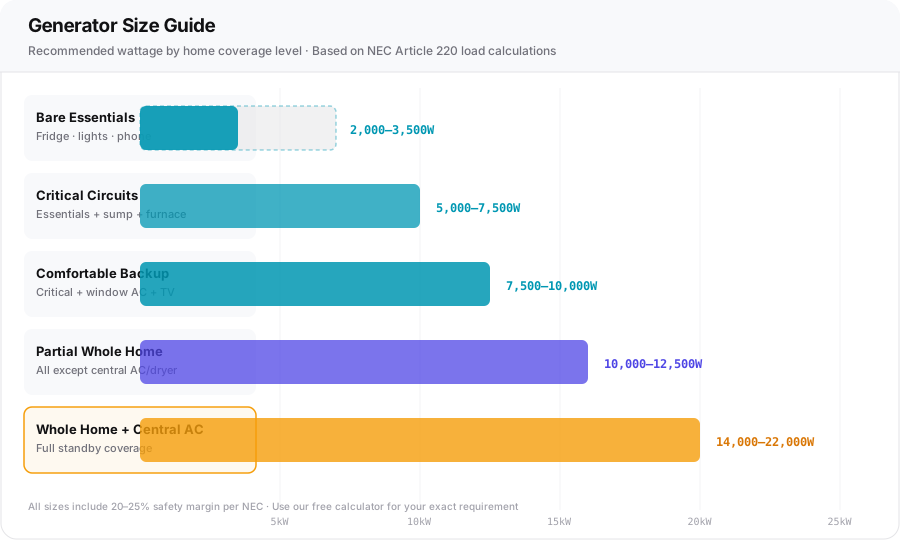
Generator size guide by coverage level — from 2,000 watts for bare essentials to 22,000 watts for whole-home standby with central AC
Generator size by coverage level. All sizes include the 20–25% safety margin required by NEC Article 220.

Understanding Your Generator Sizing Result

Once the calculator produces a recommended wattage, it helps to understand what that number represents. First, the recommendation accounts for your total running watts — that is, the continuous power all your selected appliances draw simultaneously. Furthermore, it adds the single largest startup surge, because that surge determines whether your generator can actually start your most demanding appliance.

The result also incorporates the 80% load rule. Specifically, generators should not run continuously above 80% of their rated capacity; otherwise, they overheat and wear prematurely. Therefore, the calculator divides your peak load by 0.80 to arrive at the recommended size. As a result, the recommended generator runs comfortably within its safe operating range rather than straining at its limit.

Finally, treat the recommendation as a minimum rather than an exact target. In practice, choosing the next standard size up provides valuable headroom for future appliances and ensures quieter, more efficient operation. Additionally, if you anticipate adding major loads — an EV charger or a hot tub, for example — factor those in now. Consequently, a modest amount of oversizing is almost always the wiser long-term decision.

Generator Size for Specific Appliances

Jump to a detailed sizing guide for the exact appliance or home size you need to power.

Free Tool

Get Your Free Generator Size Recommendation

Use our free calculator to get an exact generator size recommendation for your specific appliances — takes less than 2 minutes.

Calculate Generator Size

Frequently Asked Questions

Related Generator Tools