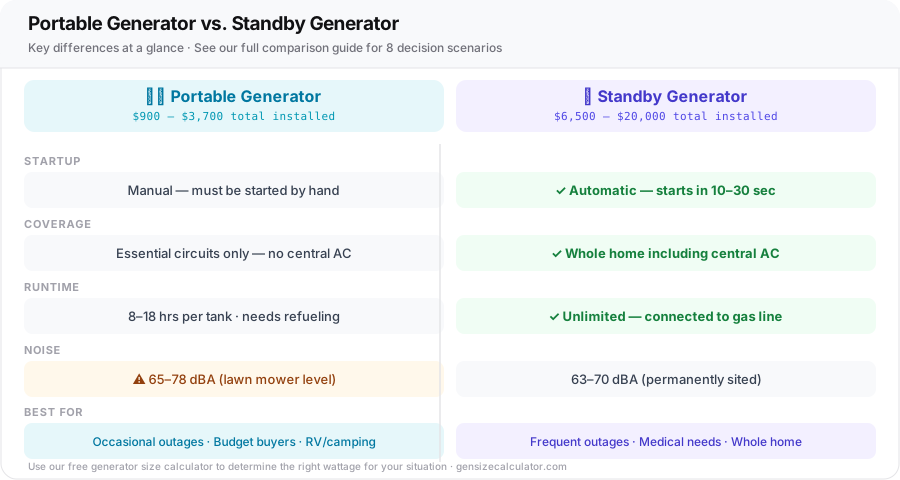
Portable vs Standby Generator

Portable Generator vs Standby Generator

Standby wins on automation and whole-home coverage. Portable wins on cost and flexibility. The right answer depends entirely on your outage frequency, budget, and coverage needs — here's how to decide.

$900–$3.7K
Portable total cost
$6.5K–$20K
Standby total cost
10–30 sec
Standby auto-start time

Quick Answer

Get a portable generator if you have occasional outages and a limited budget — a quality 5,500W portable with a transfer switch costs under $2,000 and covers essential circuits. Get a standby generator if you have frequent or extended outages, medical equipment, or want automatic whole-home protection including central AC. The cost gap is large ($1,500 vs $10,000+), but standby delivers automation and coverage that portables fundamentally cannot match.

$900–$3,700
Portable total
$6,500–$20K
Standby total
10–30 sec
Standby auto-on
No central AC
Portable limit
Published Updated Reviewed by Generator Size Calculator Editorial Team

Key Takeaways

  • Portable generators cost 5–10× less than standby but require manual setup and cannot run central AC reliably.
  • Standby generators start automatically within 10–30 seconds — before your refrigerator warms up or you wake from sleep.
  • For occasional outages (2–3 per year under 24 hours), a portable generator is almost always the better financial decision.
  • Medical equipment dependency, all-electric homes, or central AC requirements strongly favor standby generators.
  • Standby generators add 3–5% of home value; portable generators add zero appraised value.

Portable vs Standby — Full Comparison

Factor
🏕️ Portable
🏠 Standby
Typical unit cost
$500–$2,500
$3,500–$12,000
Installation cost
$400–$1,200 (switch)
$3,000–$8,000 (full install)
Total first-year cost
$900–$3,700
$6,500–$20,000
Annual maintenance
$0–$200 (DIY ok)
$150–$400 (dealer required)
10-year total cost of ownership
$5,000–$8,000
$10,000–$28,000
Power output range
1,000–15,000W
7,500–30,000W+
Whole-home coverage
Partial (no central AC)
Full (including AC)
Automatic startup
❌ Manual only
✅ Within 10–30 seconds
Fuel storage required
✅ 5–10 gal on hand
❌ Connected to gas line
Runtime limit
8–18 hrs per tank
Unlimited (gas line)
Noise level
65–78 dBA
63–70 dBA
Weather protection needed
✅ Required outdoors
✅ Permanently weatherproofed
Portability / multiple uses
✅ Camping, RV, jobsite
❌ Permanently installed
CO risk (indoor misuse)
⚠️ High if misused
✅ Outdoor install standard
Best for outage frequency
Occasional (1–3×/yr)
Frequent or multi-day

Which Is Right for Your Situation?

Eight common scenarios with a clear recommendation and the reasoning behind it.

PORTABLE

Occasional outages (2–3 per year, under 12 hours)

A standby system costs $8,000–$20,000 installed. At 2 outages/year lasting under 12 hours, you would never recoup that investment. A quality 5,500W portable with a manual transfer switch handles essentials for under $1,500 total.

STANDBY

Frequent or extended outages (ice storms, hurricane zones)

Multi-day outages without heat or cooling are dangerous. Standby generators start automatically — even while you sleep or when you are away. For hurricane-prone or ice-storm areas, the automation and unlimited runtime justify the cost premium.

STANDBY

Medical equipment (CPAP, oxygen, dialysis)

Medical dependency removes the option to manually start a generator in an emergency. Standby systems activate within seconds of a power loss, before any interruption affects sensitive medical equipment. This is not a case where cost should be the deciding factor.

PORTABLE

Sump pump + refrigerator + occasional lights

This essential load profile adds up to 1,500–3,000W running — well within any 5,000W+ portable. You do not need whole-home coverage for this scenario. A 5,500W dual-fuel portable with a manual transfer switch is entirely adequate.

STANDBY

Running central AC during outages

A 2-ton central AC surges to 7,800W at startup. Paired with other home loads, you need 12,000W+ — which puts you at the top of portable generator pricing and capability. The Generac Guardian 14kW standby does this automatically at lower cost than a max-rated portable plus transfer switch.

PORTABLE

RV, camping, job sites, and home backup

Standby generators are bolted to a concrete pad — they go nowhere. A portable inverter generator (2,000–4,500W) or conventional portable (5,500–12,000W) covers all mobile use cases plus serves as emergency home backup with a manual transfer switch.

PORTABLE

Weekend or vacation home

A standby generator at a vacation property requires gas line infrastructure, authorized dealer proximity for service, and the cost of installation at a property you occupy part-time. A portable stored in the garage and deployed when needed is far more practical.

STANDBY

Home value and resale consideration

A permanently installed standby generator adds $5,000–$12,000 in appraised home value according to Consumer Reports and Remodeling Magazine's Cost vs. Value report. Portable generators add no resale value. If you are planning to sell within 5–10 years, a standby may partially pay for itself.

Types of Portable Generators

Conventional open-frame

3,500–12,500W

Pros

  • +Highest wattage per dollar
  • +Handles power tools and pumps well
  • +Widely available

Cons

  • Loudest (70–78 dBA)
  • Fixed RPM — inefficient at partial load
  • Produces less clean power

Best for: Power tools, sump pumps, high-wattage emergency loads

Inverter generator

1,000–7,500W

Pros

  • +Quietest (50–65 dBA)
  • +Most fuel-efficient at partial load
  • +Clean power for electronics
  • +Lightweight and portable

Cons

  • Lower max wattage
  • Higher cost per watt than conventional
  • Cannot parallel-run cheaply

Best for: Sensitive electronics, camping, RV, quiet neighborhoods

Dual-fuel (gasoline + propane)

3,500–15,000W

Pros

  • +Fuel flexibility during emergencies
  • +Propane stores indefinitely
  • +Propane starts reliably in cold

Cons

  • Slightly lower output on propane vs. gasoline
  • Heavier than single-fuel models

Best for: Emergency preparedness, regions with fuel shortages during disasters

The True Cost Comparison: 10-Year View

Most cost comparisons focus on purchase price. A more complete picture includes installation, maintenance, fuel, and the probability-weighted cost of an outage without adequate power.

Cost ElementPortable (5,500W)Standby (14kW)
Generator unit$700–$1,200$4,000–$5,500
Transfer switch + installation$400–$1,200$3,000–$6,500
Annual maintenance (×10 years)$0–$1,000 (DIY ok)$2,000–$4,000
Fuel (20 hrs/year × 10 years)$800–$1,200$600–$1,000 (gas line)
10-year total$1,900–$4,600$9,600–$17,000

The financial case for a portable generator is clear if outages are infrequent and you have no coverage requirements beyond essentials. The standby premium is justified by automation, medical equipment protection, whole-home coverage, and home value addition.

The Case for Each — Summarized

Choose a portable generator if:

  • Your area experiences outages 1–4 times per year, typically under 24 hours
  • You can tolerate manually setting up the generator when an outage occurs
  • Essential circuits (refrigerator, sump pump, lights, phone charging) are adequate coverage
  • You also want the generator for camping, RV use, or job-site power
  • Budget is a primary constraint

Choose a standby generator if:

  • You have medical equipment requiring uninterrupted power
  • You travel frequently or cannot always be home to manually start a generator
  • Your area has frequent or extended outages (hurricane zone, ice storm corridor, rural area with aging infrastructure)
  • You need to run central air conditioning during summer outages
  • You have elderly family members, young children, or others who cannot manage a portable generator
  • You are planning to sell your home and want to add value

Free Tool

Not Sure What Size You Need?

Whether you go portable or standby, start with the right wattage. Our calculator gives you both running watts and surge watts — the two numbers every purchase decision requires.

Calculate My Generator Size

Frequently Asked Questions

Helpful Next Steps

Related Generator Tools